Vast secures $500M to advance private space station projects
Vast raises $500M to advance private Haven space stations, funding Haven-1 pathfinder and planned Haven-2 modules.
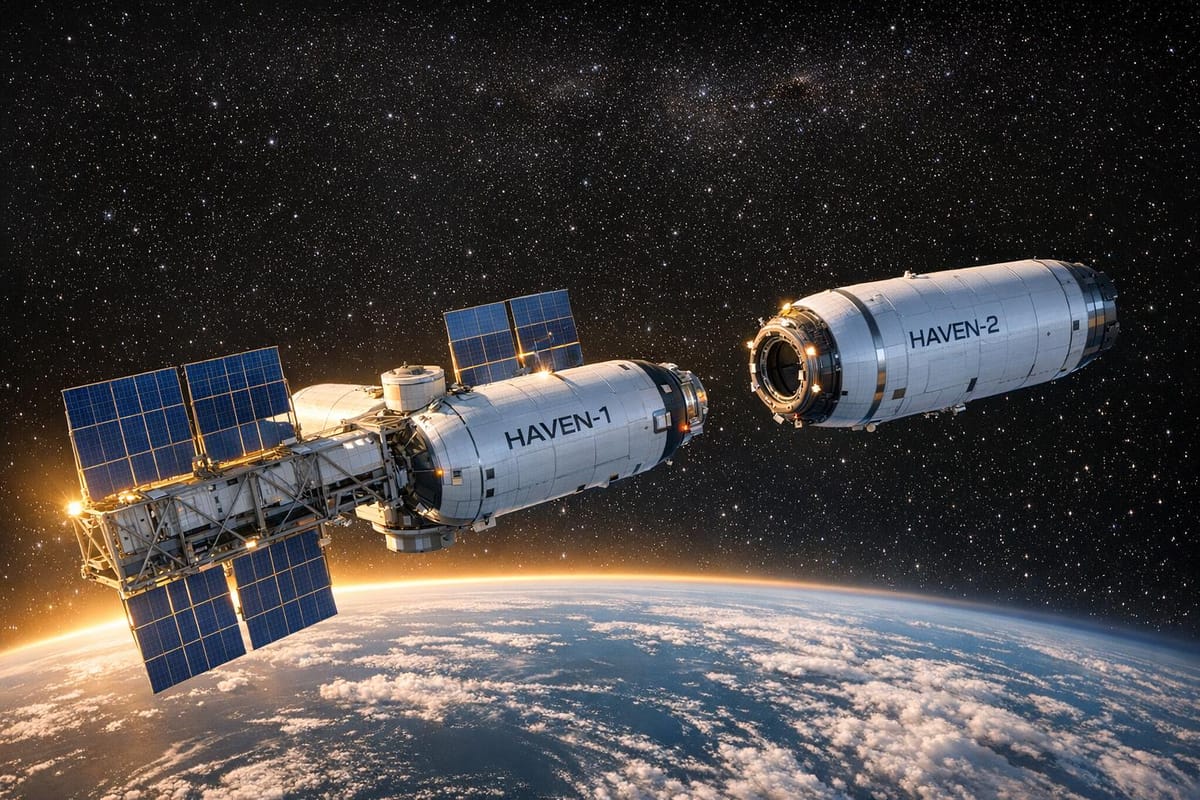
California-based space company Vast has taken a significant step toward its vision of pioneering private space stations with its recent announcement of $500 million in new funding. The investment marks a major milestone for the company as it continues developing its Haven project, a series of modular space stations designed to redefine human activity in low Earth orbit (LEO).
Expanding Horizons in Low Earth Orbit
The $500 million consists of $300 million in Series A equity funding and $200 million in debt financing, according to Vast. The funds will be allocated toward expanding the company’s facilities, increasing its workforce, and advancing the development of its Haven-2 modules, which are envisioned as successors to the International Space Station (ISS). Vast aims to ensure a continuous human presence in LEO for the United States and allied nations.
"This investment underscores the market's strong conviction in both our strategy and our engineering", said Max Haot, CEO of Vast, in a statement. "The low Earth orbit economy is at a pivotal inflection point, poised for rapid growth. Vast's Haven stations are engineered to deliver safe, cost-effective access to microgravity research and in-space manufacturing, empowering government and commercial partners to unlock the full commercial promise of this next era for space."
Aiming for Long-Term Goals
Vast, founded in 2021, is working to establish itself as a leader in the private space station sector. The company envisions "billions of people living and thriving in space", according to its founder and first investor, Jed McCaleb. He noted, "Achieving a goal of this magnitude requires deliberate stepping stones, and our strategy of building, testing, and iterating with real hardware is delivering results. It is exciting to welcome additional investors who recognize Vast's long-term potential and share our belief in making this vision a reality."
Vast is planning ambitious timelines for its Haven projects. The first Haven-2 module is scheduled for launch in 2028, with additional modules expected every six months until 2032. These modules are designed to support a continuous human presence in orbit, particularly as the ISS approaches its planned retirement at the end of 2030.
Before the Haven-2 project gets underway, Vast has laid groundwork with its pathfinder station, Haven-1. Scheduled to launch in 2026 aboard a SpaceX Falcon 9 rocket, Haven-1 is a single-module prototype that will allow the company to test technologies and processes vital for future operations. Vast has already demonstrated key Haven-1 technologies on the Haven-Demo spacecraft, an uncrewed 1,100-pound satellite that was launched into LEO in November last year.
Key Investors and Partnerships
The financing round was led by Balerion Space Ventures, with participation from a diverse group of investors, including IQT, Qatar Investment Authority, Mitsui & Co. Ltd, MUFG, Nikon Corporation, Stellar Ventures, Space Capital, and Earthrise Ventures. A.C. Charania, a current advisor to Balerion and a former NASA chief technologist, has joined Vast’s board of directors as part of the funding agreement.
Vast’s collaboration with SpaceX is also central to its strategy. In addition to launching Haven-1, SpaceX will also support Vast’s participation in NASA’s private astronaut program. Vast has been tapped to operate the sixth private astronaut mission to the ISS, slated for no earlier than 2027, using SpaceX hardware, including a Falcon 9 rocket and a Dragon crew capsule.
Competitive Landscape
The race to develop private space stations is heating up, with multiple companies competing for dominance in the emerging LEO economy. Vast joins other U.S.-based innovators like Axiom Space, which plans to attach its own modules to the ISS starting in 2027 before transitioning to a free-flying private station. Blue Origin and Sierra Space have partnered on the Orbital Reef project, while NanoRacks and Voyager Space are working on their Starlab station, both targeting launches by the late 2020s.
Looking Ahead
With its robust funding, technological advancements, and partnerships, Vast is positioning itself as a major player in the post-ISS era of space exploration. Its forward-thinking Haven project represents a significant step toward realizing the commercial and scientific potential of private space stations. As Vast continues to develop its infrastructure and technologies, the company is poised to play a pivotal role in shaping the future of human presence in orbit.
Comments ()