SpaceX Starship V3 nearing launch milestone to revolutionize space
SpaceX readies Starship V3 for an April test with larger Super Heavy, Raptor 3 engines and orbital refueling plans.
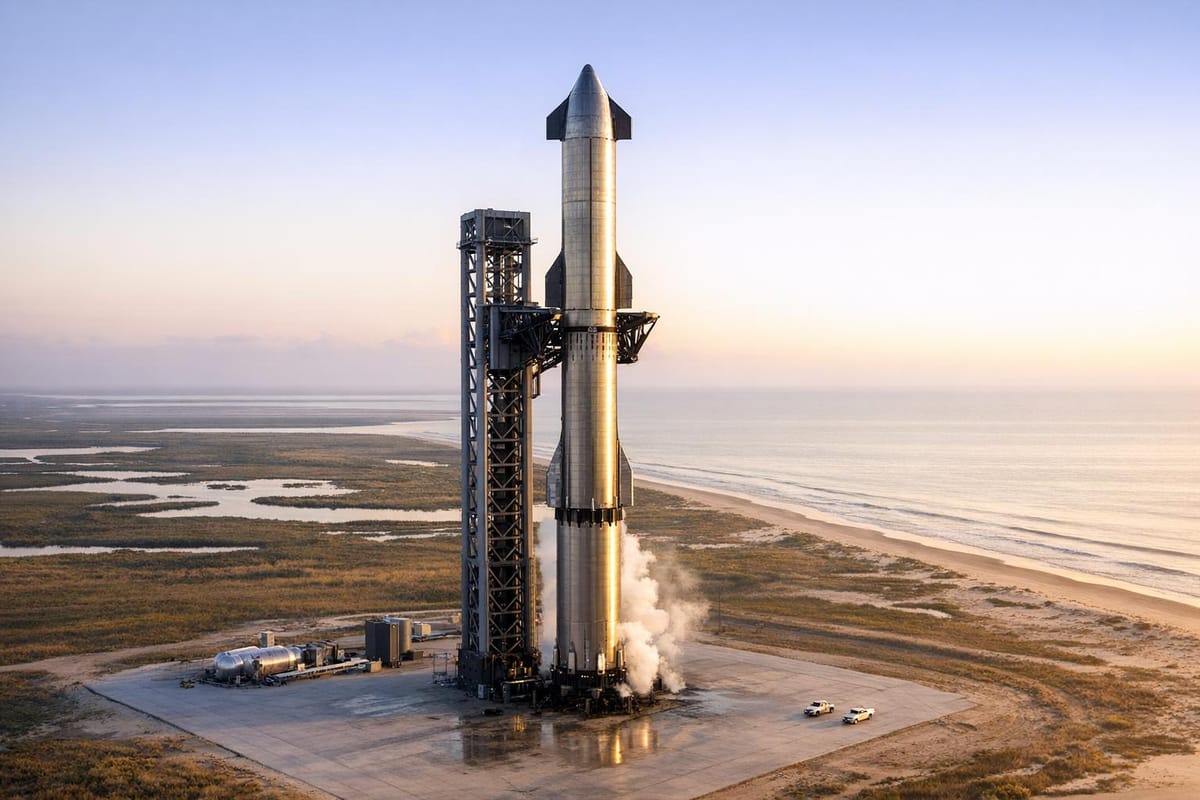
SpaceX is on the verge of a groundbreaking moment in space exploration as its next-generation Starship V3 prepares for its first test launch, scheduled for April. This latest iteration, referred to as "Version 3", is expected to significantly advance space travel with its enhanced design and capabilities.
A Bigger, More Powerful Starship
The new Starship V3 boasts several key upgrades over its predecessors. The Super Heavy booster and Starship upper stage have been slightly extended in height, allowing for improved performance. Powered by upgraded Raptor 3 engines, the rocket offers stronger and more efficient thrust. Additionally, the vehicle has expanded propellant capacity, enabling it to carry payloads of over 100 tons to low Earth orbit - nearly triple the payload capacity of the previous version, which was limited to around 35 tons.
This increase in payload capacity is a crucial step toward fulfilling Elon Musk’s vision of colonizing Mars. Successful Mars missions will require transporting vast amounts of cargo, fuel, and eventually people, and the enhanced capabilities of Starship V3 aim to meet those demands.
Orbital Refueling: A Game Changer
One of the most critical advancements in the Starship V3 is its orbital refueling capability. This feature is essential for SpaceX’s broader ambition of exploring deep space. By enabling large amounts of propellant to be transported and transferred in orbit, the Starship system could transition from being merely a rocket to becoming a fully operational transport system. Without this technology, large-scale missions to destinations such as the Moon and Mars would not be feasible.
Progress at Starbase
In a recent update shared by SpaceX, the company confirmed that its initial activation campaign for the Super Heavy V3 prototype and Starbase Pad 2 has been successfully completed. This testing involved loading cryogenic fuel and oxidizer into the V3 vehicle for the first time. While a 10-engine static fire test ended early due to a ground-side issue, SpaceX reported that other elements of the test campaign had been successful.
On March 18, 2026, SpaceX shared the following via social media:
"Initial Super Heavy V3 and Starbase Pad 2 activation campaign complete, wrapping up several days of testing that loaded cryogenic fuel and oxidizer on a V3 vehicle for the first time. While the 10-engine static fire ended early due to a ground-side issue, we saw successful… pic.twitter.com/uHGji17srv"
- SpaceX (@SpaceX) March 18, 2026
Affordable Space Access
SpaceX’s plans for the Starship V3 emphasize reusability, which could dramatically lower the cost of space access. The company aims to reduce marginal launch costs by up to tenfold compared to current industry benchmarks. Presently, sending a kilogram of cargo to orbit costs thousands of dollars. By significantly lowering these costs, SpaceX could open the door to a new era of space exploration and commercialization.
This affordability could facilitate the mass deployment of satellite constellations, the transportation of larger scientific payloads, and even affordable human space travel. As SpaceX envisions, the Moon could evolve from a destination to a permanent habitat.
The Road to the Moon and Mars
NASA is already counting on Starship’s capabilities for its Artemis program. A successful test flight of Starship V3 this spring is crucial to maintaining the timeline for a planned 2028 mission to deliver astronauts to the Moon’s South Pole. The ultimate aim is to establish a permanently crewed science station on the lunar surface.
While Elon Musk continues to champion his long-term goal of building a self-sustaining city on Mars, he has recently shifted focus to the Moon as a more immediate proving ground. The Moon’s proximity, with launch windows every 10 days compared to Mars’s 26-month alignment cycle, makes it an ideal location for testing the technologies necessary for interplanetary settlement.
Musk expressed his excitement for the upcoming launch in a social media post, stating, "The first V3 flight is getting closer to launch." With April just around the corner, the countdown is indeed on for what could be a transformative moment in the future of space exploration.
Comments ()