SpaceX Prepares to Launch Starlink Satellites with Sonic Boom Warnings Pending
SpaceX will launch 25 Starlink satellites from Vandenberg on March 20, 2026; Central Coast residents may hear sonic booms.
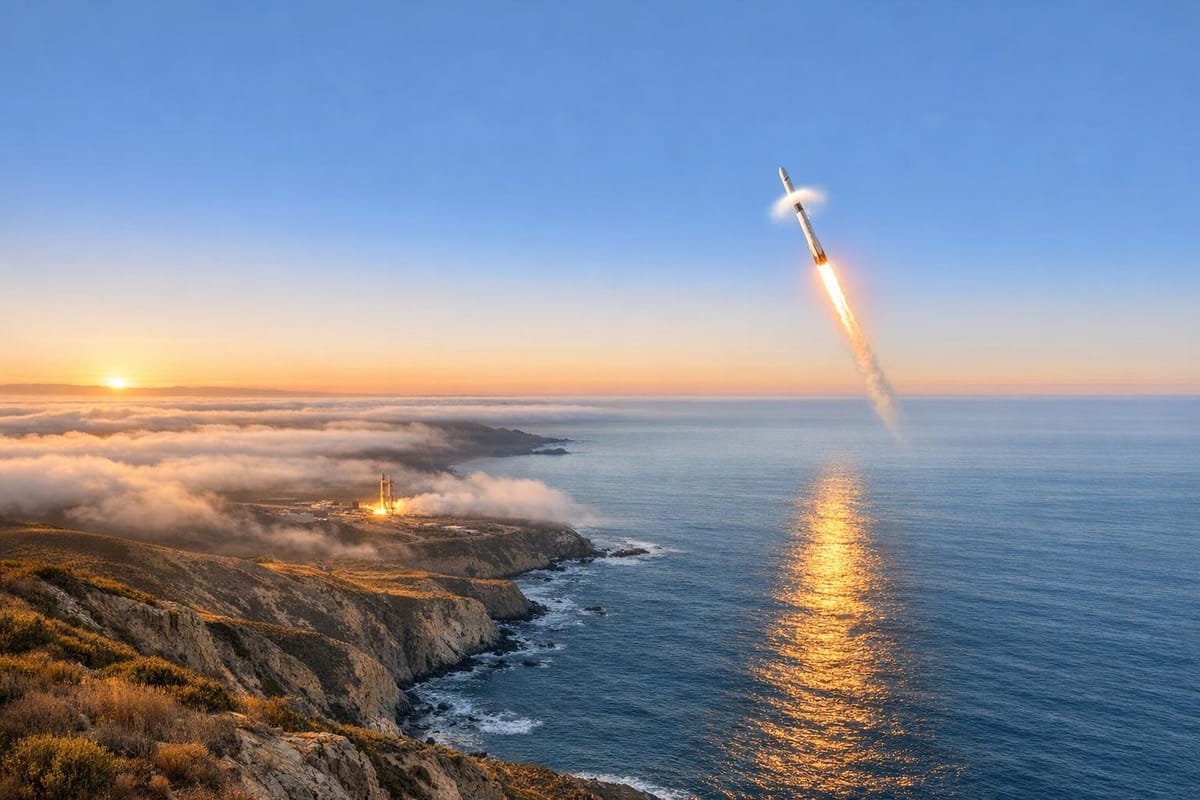
Residents along California's Central Coast should brace themselves for the possibility of sonic booms as SpaceX gears up for another significant launch from Vandenberg Space Force Base. Scheduled for March 20, 2026, the mission will send 25 Starlink satellites into low-Earth orbit, with the launch window set between 2:48 a.m. and 6:48 p.m. PT.
Falcon 9 Booster to Make a Droneship Landing
The launch, slated to take place at Space Launch Complex-4 East, will feature a Falcon 9 rocket. The first-stage booster being used for this mission will be making its fourth flight, having previously supported the NROL-105 mission and two earlier Starlink launches. Following stage separation, the booster is expected to return for a landing on the droneship 'Of Course I Still Love You,' stationed in the Pacific Ocean.
Falcon 9 plays a critical role in SpaceX's operations, renowned for its reusable design. To date, the rocket has completed 614 missions, with 568 successful landings and 534 reflights. This reusability significantly reduces the cost of delivering payloads to orbit.
Sonic Boom Warnings Issued for Central Coast Residents
SpaceX has alerted residents of Santa Barbara, San Luis Obispo, and Ventura counties of the potential for sonic booms during the mission. These booms, caused by the rocket's rapid reentry, can vary in intensity depending on weather conditions and the flight path.
Some residents may feel vibrations, while others might experience loud rattling of windows. The exact impact can differ greatly, depending on local atmospheric conditions at the time of the launch.
Addressing Community Concerns About Increased Launch Noise
With the frequency of launches from Vandenberg Space Force Base increasing, concerns from local communities have grown. To address these, the base has introduced a "Mission Update" speaker series aimed at improving communication with residents and providing clearer information about launch operations.
In addition, research efforts are underway to better understand how sonic booms affect those on the ground. The ECOBOOM program, a collaboration between Brigham Young University and California State University, Bakersfield, is studying the phenomenon in detail. Since mid-2024, the program has tracked 23 launches and collected 477 acoustic recordings from monitoring stations in the region.
The data is being used to analyze sound intensity patterns and the factors that influence how residents experience sonic booms. Reports of shaking homes and distressed pets following launches have become more common, underscoring the importance of this research.
Watch the Launch Live
Space enthusiasts will be able to follow the launch in real time via a live webcast, which will begin approximately five minutes before liftoff. The webcast will be accessible on SpaceX’s official platforms, providing a front-row view of the Falcon 9's journey to orbit.
As SpaceX continues its ambitious Starlink program, this mission represents yet another step forward in providing global satellite internet coverage. However, for those living near the launch site, the sound of progress may come with a literal boom.
Comments ()