SpaceX to Launch 119 Payloads in Significant Rideshare Mission
SpaceX’s Transporter-16 will launch 119 smallsats from Vandenberg on a Falcon 9, booster B1093 to attempt drone ship landing.
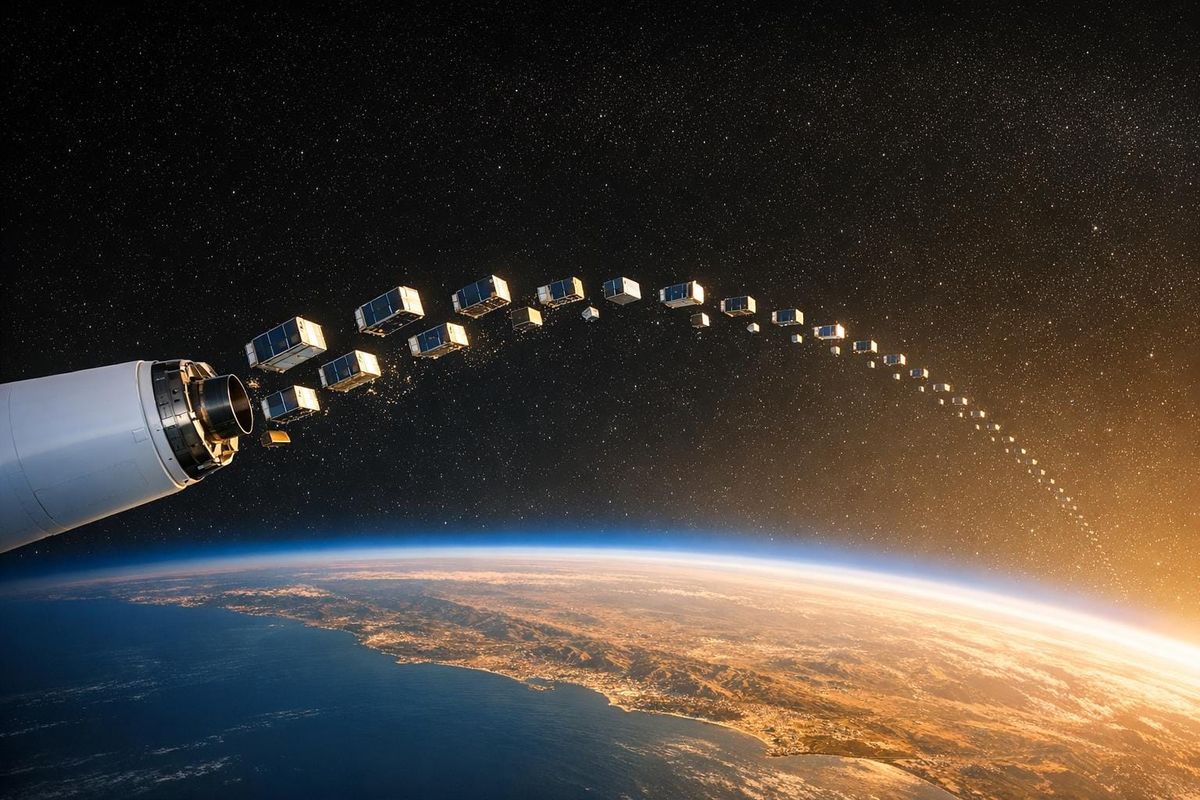
SpaceX is set to embark on its third-largest small satellite (smallsat) rideshare mission, delivering an impressive 119 payloads into a Sun-synchronous, low Earth orbit. The highly anticipated Transporter-16 mission will lift off aboard a Falcon 9 rocket from Vandenberg Space Force Base in California. Liftoff is scheduled for 4:02 a.m. PDT (7:02 a.m. EDT / 1102 UTC).
A Milestone for Falcon 9 Reusability
The Falcon 9 rocket supporting this mission, identified as booster B1093, marks its 12th launch. Its previous missions include two for the Space Development Agency and nine Starlink launches. After liftoff, B1093 is targeting a landing on the drone ship, Of Course I Still Love You, stationed in the Pacific Ocean. If successful, this recovery will bring SpaceX’s total booster landings to 592 and its 187th successful landing on this particular drone ship.
A Diverse Set of Payloads
As with SpaceX's other rideshare missions, Transporter-16 includes payloads representing a wide range of customers, from commercial companies to academic and governmental organizations around the globe. Two major players in this mission’s payload management are Exolaunch and Seops Space.
"Exolaunch is enabling launch access for more than 25 commercial, institutional, and government customers from the United States, the United Kingdom, Bulgaria, France, Finland, Greece, Italy, Spain, South Korea, Taiwan, Turkey, and more on this mission", the company said in a statement released in February. In total, Exolaunch is responsible for 57 of the mission’s payloads.
Meanwhile, Seops Space has arranged a mix of 19 payloads, consisting of 14 CubeSats and five PocketQubes. The PocketQubes, developed by Alba Orbital, are Earth observation satellites. "The Seops Transporter-16 manifest represents a truly global cross-section of the small satellite community, with payloads originating from 13 countries, including Canada, France, Malaysia, Nepal, Norway, Romania, Scotland, Spain, Switzerland, Taiwan, the United Kingdom, the United States, and Vietnam", Seops said in its statement.
Noteworthy Contributions
Among the many payloads, several stand out for their unique contributions to space technology. Varda Space is sending its sixth reentry satellite bus, designed for on-orbit manufacturing tasks. Another highlight is the Gravitas satellite from K2 Space, a massive spacecraft with cutting-edge capabilities.
The Gravitas satellite, weighing approximately two metric tons and boasting a wingspan of 40 meters when its solar panels are fully deployed, is built to generate an impressive 20 kilowatts of electricity. According to Matt Cooper, Principal Mission Assurance Engineer at K2 Space, the satellite's deployment represents a significant milestone for the company. "At K2 Space, we’re Building Bigger to deploy the largest satellites ever on orbit", stated Cooper.
SpaceX’s Continued Momentum
As SpaceX continues to expand its capabilities in satellite deployment and reusability, the Transporter-16 mission serves as a testament to the company’s growing role in enabling access to space for a diverse set of stakeholders worldwide. With 119 payloads ready for delivery and another booster recovery within reach, this mission underscores SpaceX's position as a leader in the commercial space industry.
Comments ()