SpaceX announces IPO date for June 12 with $1.8 trillion valuation
SpaceX's planned June 12 Nasdaq IPO values it at $1.8T; key details and risks for investors.
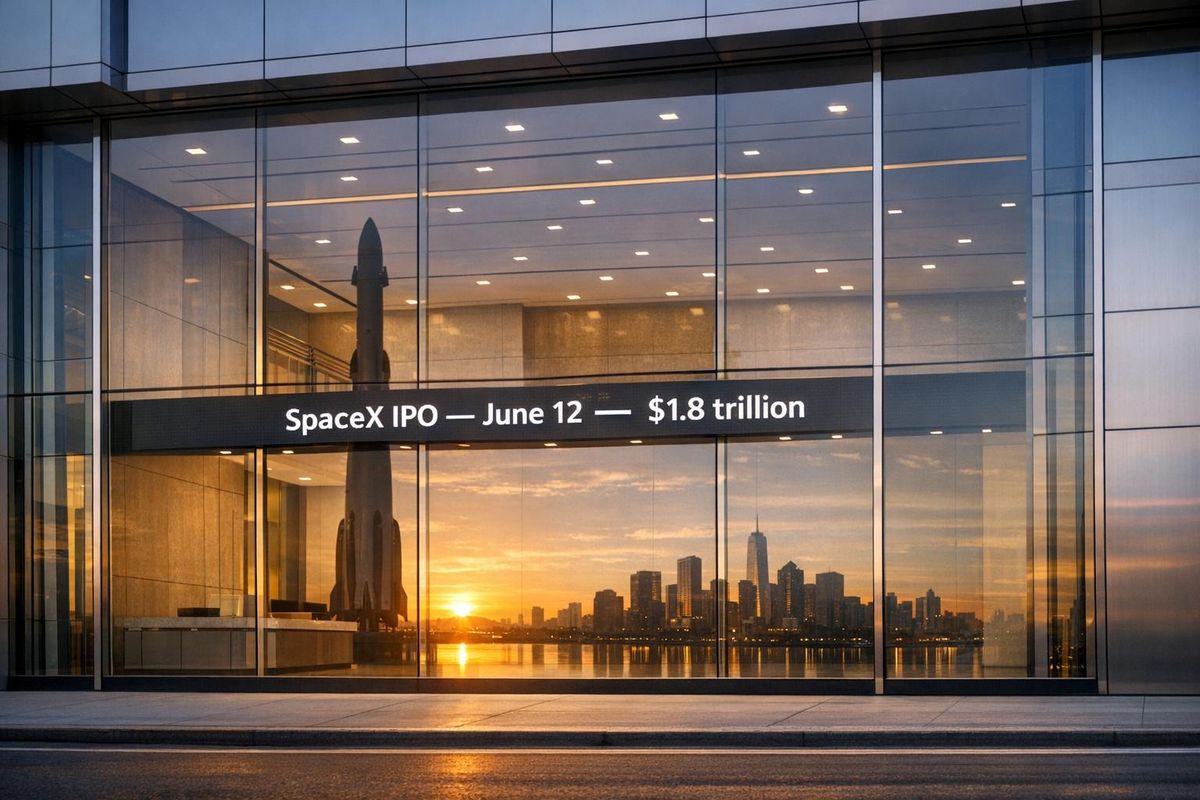
The wait is over: SpaceX, Elon Musk’s groundbreaking space and technology company, has officially set June 12 as the date for its highly anticipated initial public offering (IPO). With a valuation of approximately $1.8 trillion, this IPO is poised to be the largest in history, marking a pivotal moment for the company - and its founder.
A Landmark Valuation
SpaceX plans to go public by listing on the Nasdaq stock exchange under the ticker symbol SPAX. The company is offering 555.6 million shares at a fixed price of $135 per share, resulting in the staggering valuation of $1.8 trillion. Notably, 30% of these shares will be allocated to individual investors through select retail brokerages, making the IPO more accessible than typical public offerings.
At this valuation, SpaceX will instantly become one of the most valuable companies in the world, with its market capitalization eclipsing some of the largest names in tech and beyond. However, its high valuation has drawn questions from Wall Street about whether the company can meet the lofty expectations implicit in its price.
sbb-itb-6fb0794
A Dual Focus on Space and Artificial Intelligence
SpaceX’s diverse business structure is a key driver of its massive valuation. The company operates across three major segments: space, connectivity, and artificial intelligence (AI).
Within the space segment, SpaceX dominates the launch market with its Falcon 9 and Falcon Heavy rockets, responsible for about 80% of the global mass launched into orbit. Its connectivity arm includes the Starlink satellite broadband network, which serves customers in 164 countries. Meanwhile, the AI division includes assets like Colossus data centers and xAI, the artificial intelligence venture that was integrated into the company after SpaceX acquired X (formerly known as Twitter) earlier this year.
SpaceX has also revealed ambitions to establish AI data centers in space, further cementing its position at the intersection of the space and technology industries. The company’s total addressable market across its three segments is estimated to be as high as $28.5 trillion, according to its own projections.
Financial Performance and Challenges
Despite the excitement surrounding the IPO, investors are being encouraged to weigh the risks. SpaceX generated $18.6 billion in revenue last year, but it remains unprofitable, reporting a $1.9 billion operating loss in the first quarter of 2026. The company’s AI segment, in particular, posted significant losses of $2.4 billion during the same period.
Additionally, the valuation has raised eyebrows due to its high multiplier on revenue. At $1.8 trillion, SpaceX will trade at more than 96 times last year’s revenue, making it one of the most expensive stocks among large companies.
Musk's Influence and Control
One of the most unique aspects of SpaceX’s IPO is the level of control Elon Musk will retain over the company. The structure of the company’s voting shares ensures that Musk will have overwhelming influence, even after it becomes publicly traded. For those investing in SpaceX, complete trust in Musk’s vision and leadership is effectively part of the deal.
As Yahoo Finance Senior Autos Reporter Pras Subramanian noted, the IPO "could turn Elon Musk into the world’s first trillionaire", further underscoring the personal stakes Musk has in SpaceX’s future.
The Road Ahead
While SpaceX’s valuation and ambitious vision have inspired both optimism and skepticism, one thing is certain: the IPO will be a defining moment, not only for the company but also for the broader space and AI sectors. Investors and industry watchers alike will be following closely as SpaceX begins trading publicly on June 12.
With its unparalleled position in the space industry, groundbreaking technology, and bold ambitions, SpaceX is set to captivate the market - and the world - for years to come.
Comments ()