SpaceX Dual-Class Shares: What It Means for Investors
How SpaceX's dual-class shares concentrate voting power with insiders and what it means for investors.

SpaceX's dual-class share structure is crucial for understanding its upcoming IPO. Here's what you need to know:
- What are dual-class shares? These shares grant different voting powers. Public investors get Class A shares (1 vote/share), while insiders, like Elon Musk, hold Class B shares (10–20 votes/share).
- Why it matters: Musk retains control over SpaceX’s vision, even if he owns less than half of the company. This setup protects long-term goals like lunar industrialization and AI-driven space projects.
- Investor impact: Retail investors gain economic benefits (e.g., dividends) but have minimal influence on decisions. Insiders dominate governance.
- Risks and benefits: While the company’s growth potential is immense, public shareholders must trust Musk’s leadership, as they lack control over corporate strategy.
Before exploring ways to invest in SpaceX, weigh the benefits of SpaceX’s ambitious projects against the limited voting power this structure grants to retail investors.
Fortune Explains: Dual Class Shares I Fortune
How SpaceX's Dual-Class Structure Works

SpaceX has adopted a dual-class share structure, issuing two types of shares: Class A shares, which are available to public investors and come with one vote per share, and Class B shares, which are reserved for Elon Musk and select insiders, offering 10 to 20 votes per share. This setup is designed to protect the company from short-term activist pressures and maintain strategic stability.
By concentrating voting power in the hands of Musk and key insiders, this structure acts as a safeguard against the pressure to prioritize quarterly earnings over long-term goals. While public investors may hold a significant portion of SpaceX's equity after an IPO, the majority of voting influence will remain firmly with the company's leadership. This ensures that critical decisions align with SpaceX's overarching vision and mission.
Elon Musk's Control and Decision-Making Authority
At SpaceX, Musk's use of super-voting shares contrasts with Tesla's single-class share system. At Tesla, where Musk owns about 11% of shares, he has publicly pushed for 25% voting control to direct AI initiatives effectively. He has even suggested that without this level of control, he might relocate AI development away from Tesla. SpaceX's dual-class structure sidesteps such challenges by granting Musk concentrated authority from the outset.
One example of how this concentrated control enables bold moves is the February 2026 acquisition of xAI, valued at $250 billion. This merger integrated advanced AI computing infrastructure into SpaceX's operations, demonstrating how Musk's leadership can drive transformative initiatives.
To support its IPO transition, SpaceX is broadening its board of directors to provide additional oversight. However, the super-voting shares ensure that Musk retains ultimate decision-making authority, enabling him to pursue ambitious projects without succumbing to public market pressures. This setup allows SpaceX to stay focused on its long-term objectives, even as it faces scrutiny from public investors.
How This Structure Supports SpaceX's Long-Term Goals
The dual-class framework is critical for enabling SpaceX to tackle its most ambitious projects. Recently, the company has shifted its focus from colonizing Mars to industrializing the Moon. Musk has highlighted the advantages of lunar missions, noting that they can be launched every 10 days - compared to Mars missions, which are limited by a 26-month alignment window.
This strategic pivot demands substantial investment in advanced technologies, such as electromagnetic mass driver catapults for lunar launches and AI-powered data centers in space. These initiatives may take years, or even decades, to deliver returns, making them vulnerable under a traditional IPO structure. The dual-class system insulates SpaceX's leadership from short-term financial pressures, allowing the company to remain committed to its long-term vision.
According to Bloomberg Intelligence analyst Melissa Balzano, Falcon launches are projected to increase by over 20%, reaching 197 by 2026, with potential revenue climbing to $14.6 billion. SpaceX's IPO could raise up to $50 billion, but the dual-class structure ensures the company retains the independence needed to pursue its multi-decade technological ambitions without compromise.
How Dual-Class Shares Affect Investor Rights
SpaceX's dual-class share structure creates a distinct divide between company insiders and retail investors. Retail investors usually hold ordinary shares, granting one vote per share, while insiders control super-voting shares, each carrying 10 to 20 votes. For example, Elon Musk currently holds 79% of the voting power despite owning just 42% of SpaceX's equity. This setup illustrates how voting influence can be separated from actual ownership. Understanding these dynamics is essential for evaluating SpaceX's governance as part of your pre-IPO investment research. Here's a closer look at how this structure advantages insiders while limiting retail investor influence.
Benefits for Founders and Company Insiders
The dual-class structure provides Musk and early stakeholders with the flexibility to pursue long-term projects without external interference. As Bloomberg reporters highlighted, "The move would allow insiders such as Musk to maintain control of the company even with a minority stake". This is particularly critical for initiatives that may take decades to bear fruit, such as building space-based AI systems or establishing Moon-based manufacturing facilities.
"Under a dual-class structure that gives Musk super-voting shares, the billionaire would establish a bulwark against activist shareholders exerting changes at the company against his wishes."
- Ryan Gould and Edward Ludlow, Bloomberg
Additionally, this structure shields SpaceX's leadership from the constraints of quarterly earnings pressures. It allows the company to allocate substantial resources to experimental ventures without the risk of activist investors pushing for short-term gains.
Limitations for Retail Investors
While insiders enjoy greater operational freedom, retail investors encounter significant limitations. Public shareholders, despite owning the majority of shares, have minimal voting influence. As Daragh Thomas from Benzinga explained, "Under such structures, public shareholders typically get limited voting rights despite owning the majority of shares".
Although retail investors share the same economic rights to dividends as insiders, decisions about profit distribution or reinvestment rest with the board, which is controlled by super-voting shares. This concentration of power creates a gap in accountability. Unlike single-class structures where shareholders can vote out underperforming executives, retail investors in SpaceX are largely passive participants. They benefit from the company's success but lack the ability to influence its direction.
Risks and Benefits for Retail Investors
Investing in SpaceX through its dual-class share structure presents a mix of opportunities and challenges. On one hand, retail investors gain access to a company with strong growth potential, driven by increasing launch activity and expanding revenue streams. On the other, they face limited control over corporate decisions due to the structure of shareholder voting rights.
"Launch could drive SpaceX's biggest gains in 2026, with Falcon liftoffs rising over 20% to 197 and boosting revenue to $14.6 billion at full use and a per-launch price of $74 million"
- Melissa Balzano, Bloomberg Intelligence analyst
Potential Benefits
The dual-class share system allows SpaceX leadership to focus on ambitious, long-term goals without the distraction of short-term financial pressures. Retail investors stand to benefit from groundbreaking projects like lunar industrialization and the creation of AI data centers in space - ventures that require patience and significant upfront investment but have the potential for transformative returns. This approach enables faster progress and innovation in emerging areas of the space economy.
A notable example of this strategy is the February 2026 acquisition of xAI, which brought SpaceX's valuation to $1.25 trillion. The dual-class structure made it possible for management to integrate diverse business interests, from rockets to artificial intelligence, without needing widespread shareholder approval.
While these benefits are compelling, they come with risks that retail investors must carefully weigh.
Risks to Consider
Retail investors face limited influence over SpaceX's corporate strategy due to the dual-class structure. Ordinary shareholders are granted one vote per share, whereas insiders hold super-voting shares with 10 to 20 votes each. This imbalance restricts public shareholders' ability to challenge decisions or influence the company’s direction. Additionally, companies with dual-class shares often fail to meet the criteria for inclusion in major indices like the S&P 500, which can reduce stock liquidity and deter institutional investors.
Another concern is the reduced accountability of SpaceX's leadership. Despite impressive revenue growth, the company continues to incur significant research and development expenses, which have led to operating losses. Retail investors have limited tools to push for profitability or hold management accountable if long-term strategies falter. As a result, they are heavily reliant on the leadership’s vision and execution, with few options to intervene if expectations are not met.
Single-Class vs. Dual-Class Share Structures
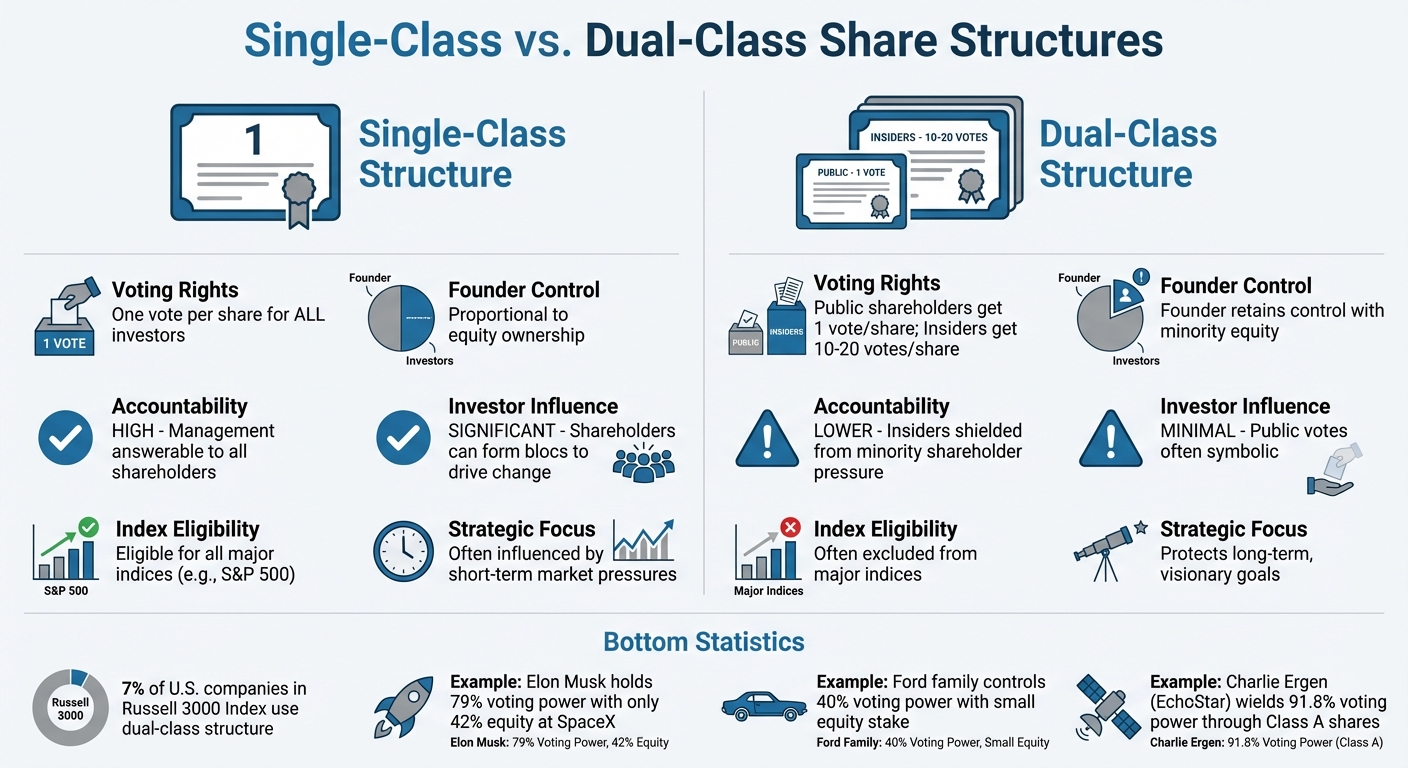
Single-Class vs Dual-Class Share Structures Comparison
Let’s dive deeper into single-class and dual-class share structures. If you're thinking about investing in SpaceX or companies with similar setups, understanding these models is key. They represent different ways of managing corporate governance, each with its own approach to balancing power among shareholders.
In a single-class structure, the rule is simple: "one share, one vote." This means voting power directly reflects the number of shares a person owns. Whether an investor holds 10 shares or 10 million, their influence matches their equity stake. This structure fosters accountability since shareholders can challenge or replace management if performance falters. Additionally, companies with single-class shares are often eligible for major stock indices, which can boost liquidity and attract institutional investors.
On the other hand, a dual-class structure operates on a tiered system, giving insiders - like founders - enhanced voting power. For instance, Elon Musk could maintain majority control of a company like SpaceX while owning less than half of its equity. A real-world example is Ford, where the Ford family controls 40% of the voting power despite holding a relatively small equity stake. Similarly, Charlie Ergen, CEO of EchoStar Communications, wields about 91.8% of the voting power through Class A shares.
Dual-class setups have their perks. They protect management from short-term market pressures and activist investors, allowing leaders to focus on long-term, ambitious projects. However, they also come with trade-offs, including reduced accountability. Around 7% of U.S. companies in the Russell 3000 Index use this model, but many face restrictions from major indices like the S&P 500 and FTSE Russell due to governance concerns. This distinction highlights how share structures can shape investor influence, particularly in companies like SpaceX.
Comparison Table: Single-Class vs. Dual-Class Shares
Here’s a quick breakdown of the key differences between these two share structures:
| Feature | Single-Class Structure | Dual-Class Structure |
|---|---|---|
| Voting Rights | One vote per share for all investors | Public shareholders get one vote per share; insiders get enhanced voting rights |
| Founder Control | Proportional to equity ownership | Founder retains control with minority equity |
| Accountability | High; management answerable to all shareholders | Lower; insiders shielded from minority shareholder pressure |
| Investor Influence | Significant; shareholders can form blocs to drive change | Minimal; public votes often symbolic |
| Index Eligibility | Eligible for all major indices (e.g., S&P 500) | Often excluded from major indices |
| Strategic Focus | Often influenced by short-term market pressures | Protects long-term, visionary goals |
Key Takeaways
SpaceX's dual-class share structure plays a crucial role in supporting its ambitious long-term goals while keeping retail investors' influence minimal. This setup ensures that Elon Musk retains firm control over the company's strategic direction, even as SpaceX prepares for what could be the largest IPO in history. For potential investors, it's important to understand the significant disparity in voting power between company insiders and retail shareholders.
This structure protects SpaceX's bold initiatives - like lunar industrialization and space-based AI data centers - from the short-term pressures of the market. However, it also means retail investors will have almost no say in corporate governance and limited mechanisms to hold leadership accountable.
This imbalance highlights the inherent trade-off when investing in SpaceX. As a retail investor, you're essentially placing your trust in Musk's leadership rather than relying on traditional shareholder influence. While the growth potential is immense, you should carefully consider whether you're comfortable with this dynamic before committing.
For more information on SpaceX's valuation trends and strategies for investing in private markets, check out the SpaceX Stock Investment Guide. It provides resources to help you make informed decisions ahead of the IPO.
FAQs
Will SpaceX’s dual-class shares ever convert to one-share-one-vote?
SpaceX has yet to confirm whether it will shift from its dual-class share structure to a one-share-one-vote system. The company is still working out the details of its IPO framework, and it’s possible the dual-class system will remain in place. This setup is often used by companies to give investors a stake while allowing insiders, such as Elon Musk, to retain significant control over decision-making.
How can retail investors protect themselves with limited voting power?
Retail investors need to be aware that dual-class share structures often grant insiders - such as founders or executives - a disproportionate amount of control. This setup can significantly restrict the ability of retail investors to influence important corporate decisions. By staying informed about how these structures work and what they mean, investors can make more informed and strategic choices.
Could dual-class shares keep SpaceX out of major indexes like the S&P 500?
Yes, dual-class shares could indeed stop SpaceX from being included in key indexes like the S&P 500. As of April 17, 2023, S&P Dow Jones Indices has a rule that bars companies with multiple share classes from being eligible for the S&P Composite 1500 and its related indexes, including the S&P 500. This policy is aimed at companies with share structures that restrict voting rights for certain shareholders.
Comments ()