5 Ways SpaceX Disrupts Aerospace Giants
How SpaceX cut launch costs, scaled reusable rockets, built Starlink revenue and reshaped aerospace.
SpaceX has reshaped the aerospace industry by delivering faster launches, cutting costs, and introducing reusable rockets. Here’s how they’ve disrupted legacy players like Boeing and Lockheed Martin:
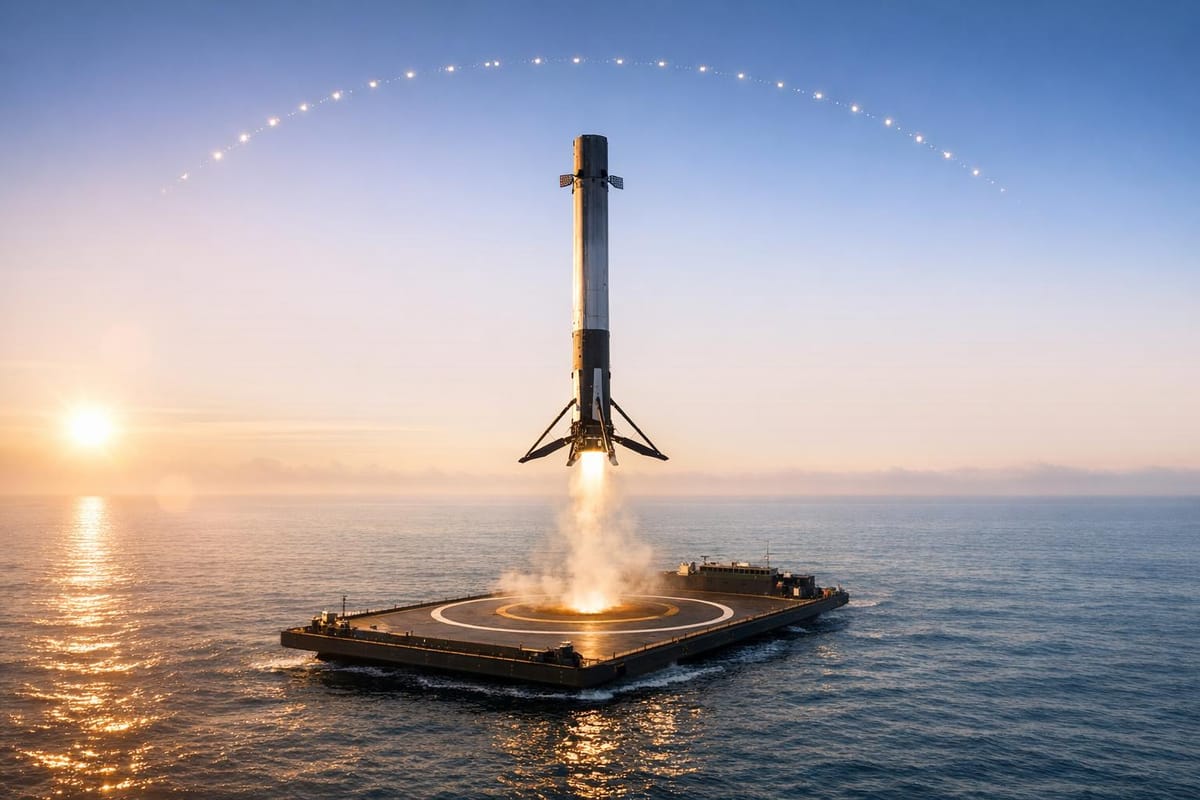
- Reusable Rockets: Falcon 9 boosters can be flown up to 32 times, reducing launch costs by 60–80%. Traditional rockets are single-use and far pricier.
- Vertical Integration: SpaceX builds 80–90% of its components in-house, avoiding supplier markups and speeding up innovation.
- High Launch Frequency: In 2025, SpaceX launched 165 rockets - averaging one every two days - dominating 52% of global launches.
- Starlink Revenue: SpaceX’s satellite internet service generates $10 billion annually, funding its ambitious projects like Starship.
- Strategic Partnerships: Key government contracts and acquisitions, like a $1.8 billion Starshield deal, strengthen SpaceX's market position.
SpaceX’s ability to lower costs, increase reliability, and scale operations has pushed competitors to rethink their strategies and pricing models. By 2026, SpaceX controls 85% of U.S. orbital launches and is valued at $800 billion, with an invest in SpaceX before its IPO expected later this year.
SpaceX Business Model - Disrupting the Space Industry
1. Reusable Rocket Technology
For decades, aerospace companies followed a straightforward yet costly model: rockets were built for single-use and discarded after one flight. SpaceX flipped this approach on its head by creating the Falcon 9 booster, a rocket designed to land, be refurbished, and fly again. This change spreads the manufacturing costs over multiple launches, drastically reducing the overall expense.
The Falcon 9's Merlin engines are key to this process. These engines can restart multiple times, performing a sequence of burns - boostback, reentry, and landing - guided by titanium grid fins and equipped with deployable landing legs. This precision recovery relies on meticulously timed engine burns, as the engines have a limited throttle range.
"The American colonies would never have been pioneered if the ships that crossed the ocean hadn't been reusable." - Elon Musk, CEO, SpaceX
This shift in design doesn't just change how rockets are launched; it also brings significant cost savings. Refurbishing a Falcon 9 booster costs about 10% of what it takes to build a new one, and reusing the hardware can slash costs by up to 65% compared to manufacturing from scratch. SpaceX proved this concept in March 2017 with the SES-10 mission, reusing booster B1021 just 11 months after its first flight. By May 2021, booster B1051 hit a major milestone, completing 10 missions and meeting Elon Musk's performance goal for the Block 5 variant.
This reusable model gives SpaceX a major advantage over traditional systems. For example, ULA's Atlas V, a single-use rocket, costs around $160 million per launch, while a Falcon 9 launch comes in at about $67 million. Although reserving fuel for recovery reduces payload capacity by 30–40%, the long-term economic benefits of reusability are reshaping the space industry.
2. Vertical Integration and In-House Manufacturing
SpaceX stands apart from competitors like Boeing and Lockheed Martin by producing about 80% of its rocket and spacecraft components in-house. This includes everything from engines and electronics to flight software and even spacesuits. By keeping production centralized, SpaceX slashes indirect costs and achieves levels of efficiency that are hard to match.
A great example of this efficiency dates back to 2006, when engineers saved $1,470 per unit by using bathroom stall latch parts for Dragon capsule hatch handles. Later, advances in 3D printing allowed the company to simplify the SuperDraco engine, reducing it from over 150 parts to just two integrated components. These kinds of innovations contribute to SpaceX's cost per kilogram to low Earth orbit being under $2,600 - dramatically lower than the $8,000 or more typical of traditional approaches.
This vertical integration doesn’t just lower costs - it also speeds up innovation. Robert Pakalski, CEO of Datum Source and a former SpaceX procurement lead, explained:
"I never worked on one rocket my entire time at SpaceX that was the same rocket from the one that launched previously".
Because SpaceX’s engineering and manufacturing teams collaborate closely, design changes can be implemented in a matter of days or weeks, compared to the months or even years required when working with external suppliers. This rapid iteration process mirrors software development, where updates are made based on real-world data. It’s this agility that gives SpaceX a significant edge in the aerospace market. This dominance has fueled intense interest in how to buy SpaceX stock among private investors.
Another way SpaceX breaks from tradition is by avoiding cost-plus contracting, a common model where companies are reimbursed for expenses plus a guaranteed profit. As SpaceX Board Member Luke Nosek put it:
"When you do [cost-plus contracting], your engineering force is brain-dead. The incentive structure destroyed their ability to create true innovation".
Instead, SpaceX sticks with fixed-price contracts, which push the company to optimize costs and maintain full control over its operations. Former Blue Origin President Rob Meyerson highlighted this advantage:
"understand every piece and component in their system in detail".
While SpaceX focuses on producing critical, high-value parts in-house - using CNC machining for precision - it outsources tens of thousands of simpler components to smaller suppliers. This selective outsourcing allows the company to streamline production while keeping tight control over schedules and resources.
3. High Launch Frequency and Reliability
In 2025, SpaceX completed an impressive 129 orbital missions - 125 Falcon 9 launches and four Starship flights. This meant they averaged a launch every 2.21 days, accounting for 54% of global launches in the first half of the year. Even more striking, the company achieved a flawless 100% success rate in the fourth quarter. Compared to traditional aerospace companies like Boeing and Lockheed Martin (operating through their ULA joint venture), SpaceX's pace is unmatched, leading many to track SpaceX stock price trends as the company dominates the market. A major driver behind this surge is SpaceX’s own Starlink program.
In 2023 alone, 65% of SpaceX's 96 Falcon missions were dedicated to deploying Starlink satellites, which also served as a testing ground to refine booster reusability. Jeff Foust, Editor and Publisher of The Space Review, summed up Starlink’s importance:
"Without Starlink, SpaceX would be a very different launch company than it is today, lacking the forcing function provided by the constellation".
This relentless launch schedule has allowed SpaceX to perfect its booster reusability at an unprecedented rate. By May 2024, SpaceX set a record with a single booster completing 21 flights, and by 2025, one booster had flown an incredible 32 times. The Falcon 9 Block 5 variant now boasts a 99.79% mission success rate, turning what was once a complex and risky endeavor into something almost routine.
This combination of reliability and rapid innovation is reshaping the industry. For example, in March 2026, NASA restructured its Artemis program to replace Boeing’s Space Launch System (SLS) with SpaceX’s Starship for critical lunar orbit operations. By early 2026, SpaceX controlled roughly 85% of all U.S. orbital launches, leaving legacy providers struggling to keep up.
The frequent launches also slash costs. Reusable Falcon 9 boosters have reduced launch prices by about 65%, bringing the cost down to approximately $2,720 per kilogram. Starship is expected to drive costs even lower, potentially cutting prices by up to 90%. Together, these advancements are fundamentally changing how the aerospace industry operates, making space more accessible than ever before. For those looking to participate in this growth, understanding the requirements for pre-IPO investing is a critical first step.
4. Starlink Satellite Network and Internet Services
SpaceX has shaken up the aerospace industry with Starlink, its satellite network that brings in $10 billion annually and serves millions of users worldwide. By March 2026, Starlink had around 7,000 active satellites in low Earth orbit and surpassed 10 million global subscribers by February 2026.
Starlink's satellites orbit at altitudes between 211 and 354 miles, much closer than the 22,000 miles typical of geostationary systems. This proximity allows Starlink to deliver latencies of just 20–40 milliseconds, compared to the over 500 milliseconds seen with traditional systems. In addition, Starlink offers download speeds ranging from 100 to 300 Mbps.
One of Starlink's standout strategies is vertical integration. SpaceX designs, manufactures, and launches its satellites using its reusable Falcon 9 rockets, creating unmatched cost efficiency. As Rocket Lab CEO Peter Beck put it:
"If you want to be competitive in there, then you have to own your own rocket and build your own satellites".
This approach not only keeps costs down but also strengthens Starlink's financial footing, a critical factor for investors.
In 2024, Starlink accounted for 58% of SpaceX's revenue and generated $600 million in free cash flow, making it the first financially self-sustaining satellite megaconstellation. This steady revenue stream plays a crucial role in funding SpaceX's ambitious Starship projects and long-term Mars colonization plans. Additionally, through its Starshield program, SpaceX is leveraging Starlink's technology to compete in the military and government communications sector, traditionally controlled by established aerospace companies.
For those interested in SpaceX's financial landscape, Starlink is clearly its revenue powerhouse. Resources like the SpaceX Stock Investment Guide provide insights into how Starlink's profitability drives the company's valuation in private markets.
5. Partnerships and Market Expansion
SpaceX's approach goes beyond just launching rockets - it’s about building a network of partnerships with governments, private companies, and international players. This strategy positions the company as a cornerstone in defense and telecommunications infrastructure.
Government contracts have been a game-changer. A $1.6 billion NASA cargo deal in December 2008 pulled SpaceX back from the brink of bankruptcy. Fast forward to 2024, and SpaceX has amassed nearly $22 billion in contracts, including a classified $1.8 billion Starshield agreement and $845 million from the U.S. Space Force. Chris Quilty, President and Co-CEO of Quilty Space, summed it up perfectly:
"NASA, and specifically the initial commercial cargo contract, is what saved the company when it was on the brink of bankruptcy".
In September 2025, SpaceX made another bold move by acquiring $17 billion in spectrum licenses from EchoStar. Half of this payment came in equity, effectively doubling EchoStar's stake in SpaceX by December, as the company’s valuation soared to $800 billion. This deal enables EchoStar’s Boost Mobile to tap into Starlink's Direct-to-Cell technology, offering nationwide coverage.
On the global stage, SpaceX is broadening its reach through collaborations with private companies like Axiom Space. These partnerships facilitate missions for international astronauts from countries such as Saudi Arabia, Turkey, Poland, and Hungary - bypassing traditional government channels. Additionally, aviation contracts bring in an average of $300,000 per customer annually.
These strategic alliances are reshaping the market. According to the SpaceX Stock Investment Guide, these collaborations contribute to a $150–200 billion premium in SpaceX’s private market valuation. By leveraging these partnerships, SpaceX not only boosts its revenue but also disrupts the dominance of traditional aerospace giants, redefining the industry's competitive landscape.
Comparison Table
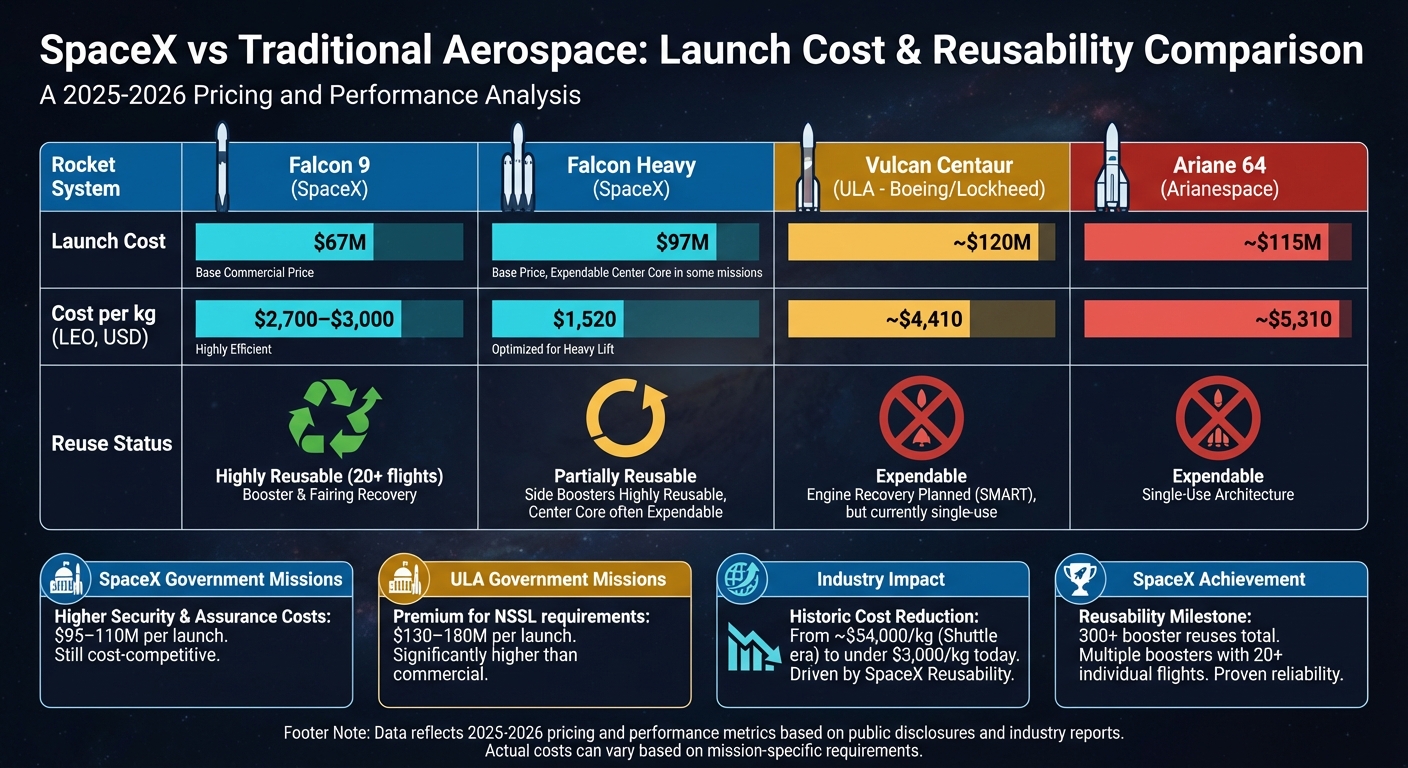
SpaceX vs Traditional Aerospace: Launch Cost and Reusability Comparison
SpaceX has set a new benchmark for cost efficiency in space launches. The Falcon 9 comes in at $67 million per launch, but its reusability slashes the marginal cost to just $15–20 million per flight. Meanwhile, ULA's Vulcan Centaur is priced at approximately $120 million per launch and remains expendable. When looking at payload costs, Falcon Heavy can deliver cargo to low Earth orbit (LEO) for $1,520 per kilogram, compared to over $10,000 per kilogram for ULA's Atlas V, and about $4,410 per kilogram for the Vulcan Centaur. Overall, SpaceX has driven launch costs down from $54,000 to less than $3,000 per kilogram. The table below highlights key metrics comparing SpaceX with its competitors.
| Vehicle | Provider | Launch Cost | Cost per kg (LEO) | Reuse Status |
|---|---|---|---|---|
| Falcon 9 | SpaceX | $67M | $2,700–$3,000 | Highly Reusable (20+ flights) |
| Falcon Heavy | SpaceX | $97M | $1,520 | Partially Reusable |
| Vulcan Centaur | ULA (Boeing/Lockheed) | ~$120M | ~$4,410 | Expendable |
| Ariane 64 | Arianespace | ~$115M | ~$5,310 | Expendable |
This data underscores the game-changing impact of SpaceX's reusable technology. With over 300 reuses recorded and individual boosters achieving more than 20 flights, SpaceX has made space missions far more economical. In contrast, traditional aerospace companies like ULA and Arianespace still rely on expendable rockets, which drive up costs. For U.S. government national security missions, SpaceX's pricing averages $95–110 million per launch, significantly lower than ULA's $130–180 million range.
Conclusion
SpaceX has revolutionized the aerospace industry through reusable rockets, vertical integration, frequent launches, satellite services, and strategic partnerships. By dramatically reducing launch costs, it has compelled traditional players like Boeing, Lockheed Martin, and Arianespace to rethink their long-standing business models. With boosters achieving over 30 flights and record turnaround times, SpaceX has demonstrated that reusability is the future of space exploration.
These transformative strategies have also created a compelling investment story. Starlink, for instance, now serves over 10 million subscribers worldwide with nearly 9,500 active satellites. This service provides a steady, high-margin revenue stream that underpins much of SpaceX's income. By owning and operating critical infrastructure, SpaceX has adopted a business model that mirrors disruption in other industries.
In December 2025, SpaceX reached an $800 billion valuation, with plans for an IPO in mid-2026 that could push its valuation to $1.5 trillion. The company's diverse revenue streams - from government contracts like the $5.9 billion Pentagon deal secured in April 2025 to commercial launches and Starlink's rapid growth - set it apart from traditional aerospace firms.
As SpaceX ventures into areas like space-based AI computing, direct-to-cell mobile services, and commercial human spaceflight, staying updated on its progress is crucial for investors. For more details on SpaceX's pre-IPO insights and market trends, visit the SpaceX Stock Investment Guide.
FAQs
How does reusing boosters affect payload capacity?
Reusing boosters slashes launch costs significantly, allowing for quicker turnaround times and more frequent launches. This approach can cut the cost per launch by as much as 70%, bringing the price of sending payloads to orbit down from about $10,000 to $2,500 per kilogram. These cost savings are making space access more affordable than ever.
Why does building parts in-house make SpaceX cheaper and faster?
Building components in-house lets SpaceX maintain more control over its production process. By reducing reliance on external suppliers, the company cuts costs, simplifies manufacturing, and speeds up development. This strategy gives SpaceX an edge when it comes to both efficiency and keeping expenses down.
How does Starlink revenue help fund Starship?
Starlink plays a key role in funding SpaceX's Starship program by generating significant profits. In the past year, SpaceX brought in approximately $8 billion, with Starlink accounting for an impressive 50% to 80% of that revenue. This influx of funds is crucial for supporting the development of Starship.
Comments ()