SpaceX delays Starship V3 test amid expedited NASA lunar goals
SpaceX delays Starship V3 first flight to early April as NASA urges faster lunar lander development.
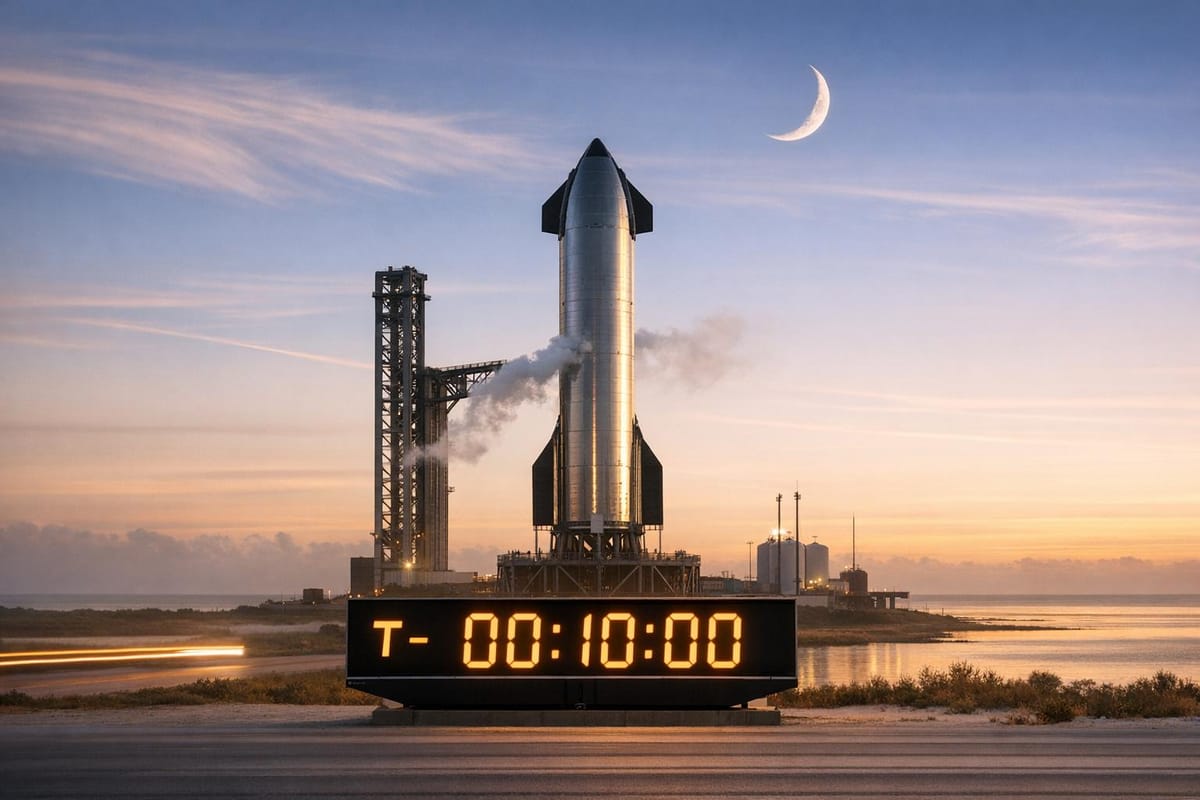
SpaceX has once again pushed back the timeline for its anticipated Starship V3 test, delaying the first flight of its next-generation rocket as NASA intensifies efforts to accelerate lunar lander development.
The launch schedule for Starship V3, a cornerstone of SpaceX's ambitions for deep space exploration, has been postponed despite earlier projections. This development unfolds as NASA puts additional pressure on the company to advance its lunar landing system, part of the broader goal of returning astronauts to the Moon.
Launch pushed to early April
On March 7, Elon Musk, founder and CEO of SpaceX, announced via social media that the inaugural flight of Starship V3 is now expected to occur "in about four weeks." This revised timeline points to a potential launch date around April 4.
This update follows a previous projection Musk made on January 26, when he estimated the next Starship launch would happen "in six weeks", targeting a date near March 9. Neither Musk nor SpaceX has disclosed the reasons behind the additional delay, though recent observations from SpaceX's Starbase facility in Texas suggested that preparations for a near-term launch were unlikely.
Progress at Starbase continues
Despite the delay, SpaceX has reported progress on certain aspects of Starship's development. On March 7, the company completed a "cryoproof" test of the upper stage for the next flight, known internally as Ship 39. This test ensures the vehicle can handle cryogenic propellants while maintaining its structural integrity. However, SpaceX did not provide a concrete launch date alongside this update.
Starship V3, an upgraded version of the existing system, boasts enhancements aimed at improving performance and reusability. The previous iteration of Starship completed its last mission in October, and SpaceX had initially planned to transition to V3 soon thereafter. In early November, a company executive described Starship V3 as "our production rocket", with an initial launch planned as early as January.
Booster damage caused setbacks
The path toward the V3 launch has been anything but smooth. On November 21, the first V3 Super Heavy booster sustained damage during testing, leading to further delays. Although SpaceX continued to target the first quarter of 2026 for Starship's twelfth flight test, the incident added uncertainty to the timeline.
Towering and clad in stainless steel, Starship is central to SpaceX's long-term ambitions. The vehicle is not only designed for Mars exploration but also serves as a critical component of NASA's plans to return humans to the lunar surface.
As SpaceX works to address setbacks and refine V3's capabilities, the postponed test underscores the challenges of developing cutting-edge space technology under the scrutiny of a demanding timeline. "In about four weeks", as Musk's latest update suggests, the spaceflight community may finally see Starship V3 take its next leap - if all goes according to plan.
Comments ()