SpaceX's Cargo Dragon to Launch on Sixth Mission to the ISS
SpaceX's Cargo Dragon will fly its sixth mission (CRS-34) to the ISS carrying ~3,000 kg of experiments and supplies.
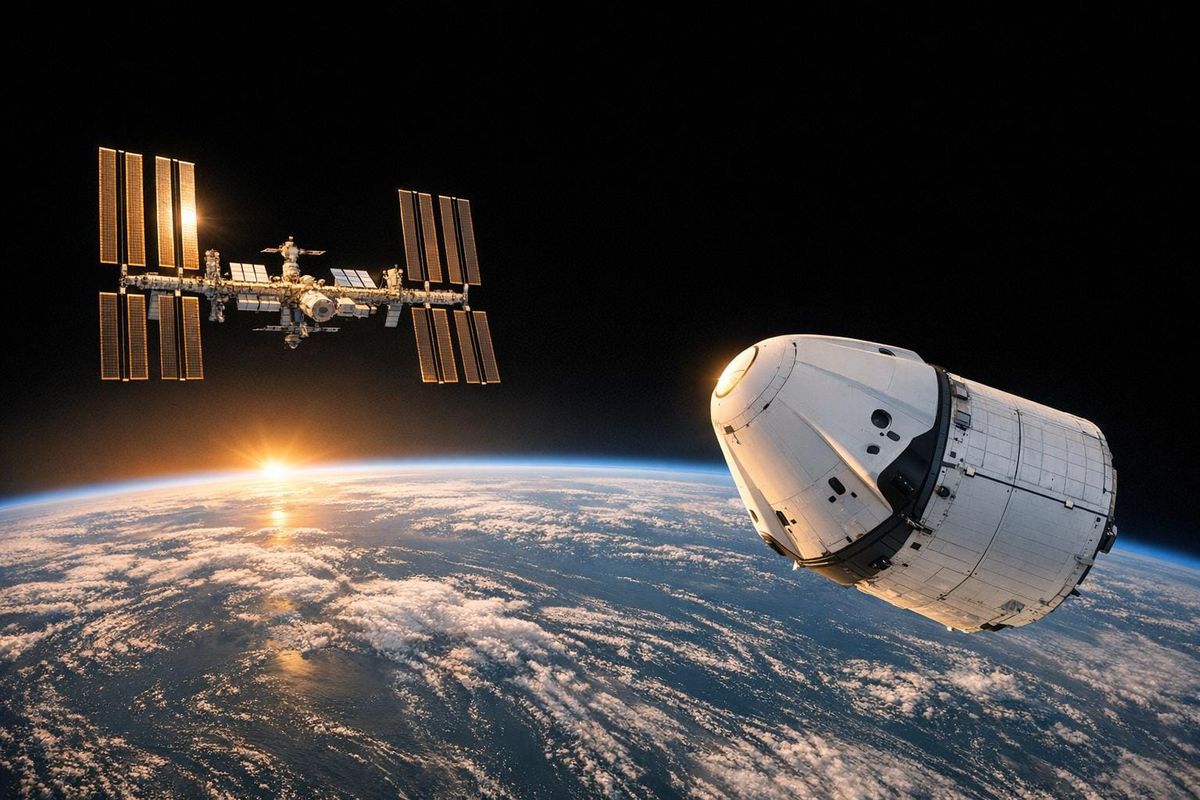
A SpaceX Cargo Dragon spacecraft is set to embark on its sixth flight to the International Space Station (ISS), marking a milestone for reusable spacecraft in cargo resupply missions. The CRS-34 mission is scheduled for liftoff at 7:16 p.m. Eastern from Launch Complex 40 at Cape Canaveral Space Force Station in Florida, carrying approximately 3,000 kilograms of cargo.
Record-Breaking Reuse
This mission will make history as the sixth flight for this particular Cargo Dragon capsule, setting a record for the design and for ISS cargo resupply since the era of the space shuttle. If the launch proceeds as planned, the spacecraft will arrive at the space station on Thursday and remain docked until mid-June. A backup opportunity for launch is available at 6:50 p.m. on Wednesday in the event of a delay. As of the day before the planned launch, weather conditions are reported to be 65% favorable.
sbb-itb-6fb0794
Critical Research Onboard
The CRS-34 mission will deliver supplies and several science experiments to the ISS, spanning topics from health to solar weather detection. One such experiment, ODYSSEY (Outcomes of microbial Dynamics during Spaceflight and in SimulatEd microgravity), aims to further NASA’s understanding of how bacteria, specifically biofilms, adapt to microgravity. Researchers from Voyager Technologies will compare bacterial behavior in space with experiments conducted in microgravity simulators on Earth.
Another notable experiment, named Green Bone, will attempt to grow human bone cells on specially treated rattan wood in the microgravity environment of the ISS. According to NASA, the findings from this research could pave the way for advancements in treating osteoporosis and healing broken bones.
Additionally, the mission will carry NASA’s STORIE imaging instrument. Once mounted on the ISS exterior, STORIE will study charged particles around Earth that could potentially impact power grids and satellites.
Preparing for the Future of Space Research
Liz Warren, deputy chief scientist for NASA’s International Space Station Program, emphasized the importance of the ongoing research aboard the ISS, particularly as NASA looks ahead to the station’s planned decommissioning in 2031. "Researchers fully anticipate transitioning to commercial platforms to continue their research in low-Earth orbit after ISS is retired", Warren said during a press conference.
The continuation of low-Earth orbit research is expected to play a vital role in future space exploration, whether in deep space or closer to Earth. Lee Echerd, senior mission manager of government and commercial mission management at SpaceX, noted the broader significance of the mission, stating, "CRS-34 enables critical research that helps people back on Earth, as well as better understand what we need to do to make life multiplanetary."
As SpaceX continues to push the limits of reusable spacecraft technology, the upcoming mission represents not only a logistical success but also a step forward in advancing humanity’s scientific knowledge and spacefaring ambitions.
Comments ()