Orbital Refueling Bottlenecks: What Investors Should Know
Technical, logistical, and regulatory bottlenecks in orbital refueling, SpaceX's solutions, projected market growth, and investor entry options.
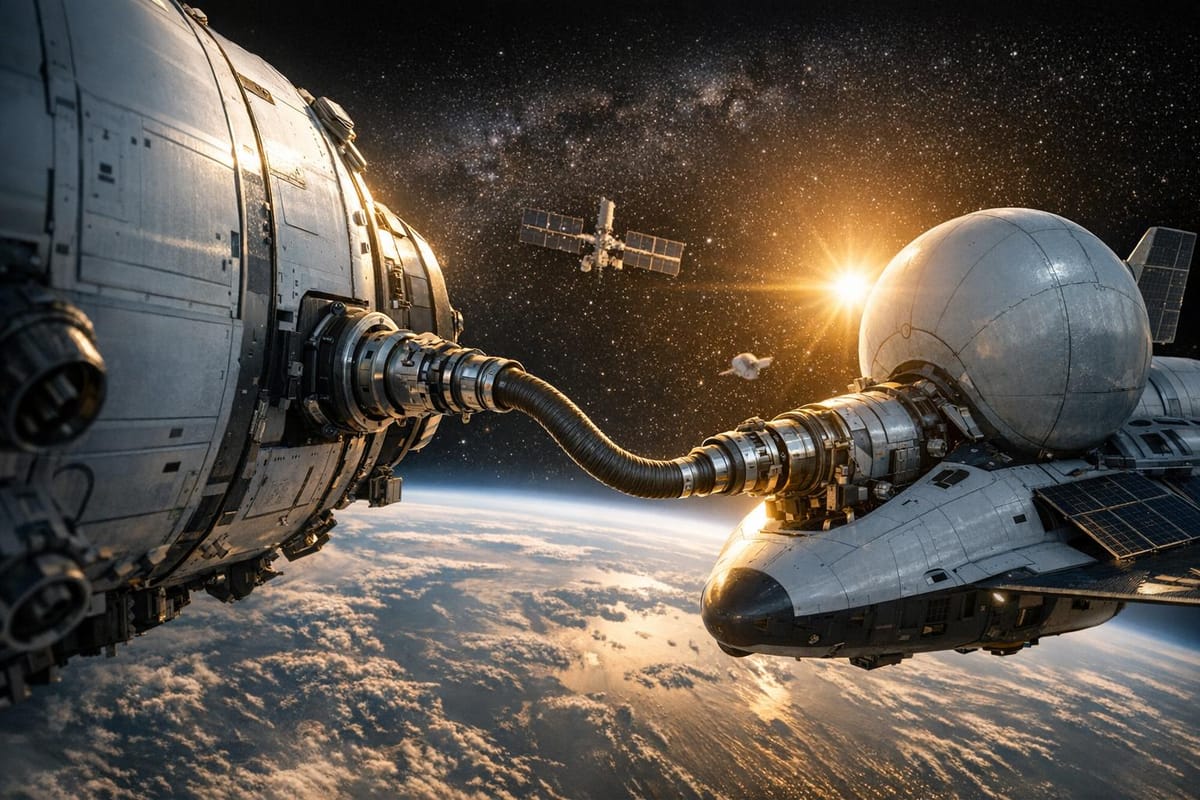
Orbital refueling is transforming space exploration by enabling spacecraft to refuel in orbit, reducing costs and making missions to the Moon, Mars, and beyond feasible. SpaceX leads this technology, with successful demonstrations like the 2024 liquid oxygen transfer and plans for large-scale ship-to-ship refueling by 2026. Key challenges include managing cryogenic fuels in microgravity, building orbital infrastructure, and navigating regulatory hurdles. Despite these obstacles, the market for orbital servicing is projected to grow from $1.2 billion in 2024 to $6.7 billion by 2034, offering significant opportunities for investors. SpaceX's advancements position it as a dominant player, with its valuation reaching $800 billion in 2025 and a potential IPO on the horizon. For investors, understanding orbital refueling's impact is crucial for seizing opportunities in this fast-growing sector.
SpaceX Shotwell Declared New Starship Refueling Method to Moon Is Not What You Think...
Major Bottlenecks in Orbital Refueling Development
Orbital refueling comes with a host of challenges that directly impact its technical viability, project timelines, and overall costs - factors that weigh heavily on investors' decisions.
Technical Problems with Propellant Transfer
Managing cryogenic fuel in microgravity is one of the toughest hurdles. Fuels like liquid methane and liquid oxygen need to stay below –244°F (120 K) to remain in a liquid state. Without gravity, these fuels don’t behave as they would on Earth. Instead, they form floating blobs, which require short bursts of rocket thrust (settling thrust) to stabilize and ensure smooth transfer.
Even minor heat exposure can cause fuel to boil off, increasing tank pressure and leading to fuel loss. Currently, the technology for keeping cryogenic fuels stable in space is limited to about 14 hours. The components involved - automated cryocouplers, flow meters, and vacuum-jacketed plumbing - must function perfectly in microgravity, where tiny bubbles can cling to tank walls and disrupt heat transfer. On top of that, managing the movement of up to 1,200 metric tons of liquid fuel within tanks adds another layer of complexity.
"The issue is it is a significant development challenge to do what they're trying to do … We have to get on top of this propellant transfer problem. It is the right problem to try and solve."
- Amit Kshatriya, Deputy Associate Administrator for the Moon to Mars Program, NASA
Infrastructure and Supply Chain Gaps
Logistics also pose a major obstacle. For example, a single Starship launch currently requires over 200 tanker truck deliveries of propellants, and lunar missions could demand between 8 and 19 tanker launches just to supply fuel .
Adding to the challenge is the lack of permanent orbital infrastructure. Without dedicated fuel depots or "gas stations in space", missions rely on complex, time-sensitive ship-to-ship transfers, during which boil-off can waste precious fuel. Another issue is the absence of standardized refueling adapters, which makes it difficult for different spacecraft or fuel depots to connect efficiently - an obstacle to scaling operations.
To tackle some of these gaps, SpaceX began building an air separation plant at its Starbase facility in Texas in September 2025. This plant will produce liquid oxygen and nitrogen, delivering them through a 1,000-foot pipeline directly to storage tanks. Additionally, SpaceX is seeking FAA approval to ramp up to 120 launches per year from Florida, aiming to meet the growing demand for orbital refueling and satellite launches.
Regulatory and Safety Requirements
Regulatory barriers further complicate scaling up operations. For instance, increasing annual launches from 25 to 120 requires additional FAA clearances. Expansion plans also trigger environmental reviews. When SpaceX proposed adding 21 acres to its Starbase facility - 18 of which are undeveloped wetlands - it needed approval from the US Army Corps of Engineers and had to submit detailed Environmental Impact Statements.
Safety protocols add another layer of complexity. The volatile nature of cryogenic fuels means refueling must happen externally, away from crewed platforms. For example, NASA’s Robotic Refueling Mission 3 (RRM3) was conducted outside the International Space Station to avoid the risks that cryogenics pose in enclosed environments.
There’s also a challenge with data sharing. Under NASA's Tipping Point awards, private companies retain ownership of technical data, limiting NASA’s ability to share critical information with the broader research community. This makes it harder to establish universal safety standards.
"Data-right restrictions are a big challenge with the way that we're procuring all of our cryogenic fluid management systems... we can't disclose the design details or the specifics to the community, which is necessary for model validation."
- John Dankanich, NASA Lead for In-Space Transportation
While these obstacles are formidable, they also create opportunities for companies that can solve them. For investors, these challenges represent both risk and potential reward. Firms that successfully navigate the technical, logistical, and regulatory complexities stand to gain a strong foothold in the fast-growing space logistics market.
How SpaceX Plans to Solve Orbital Refueling Problems
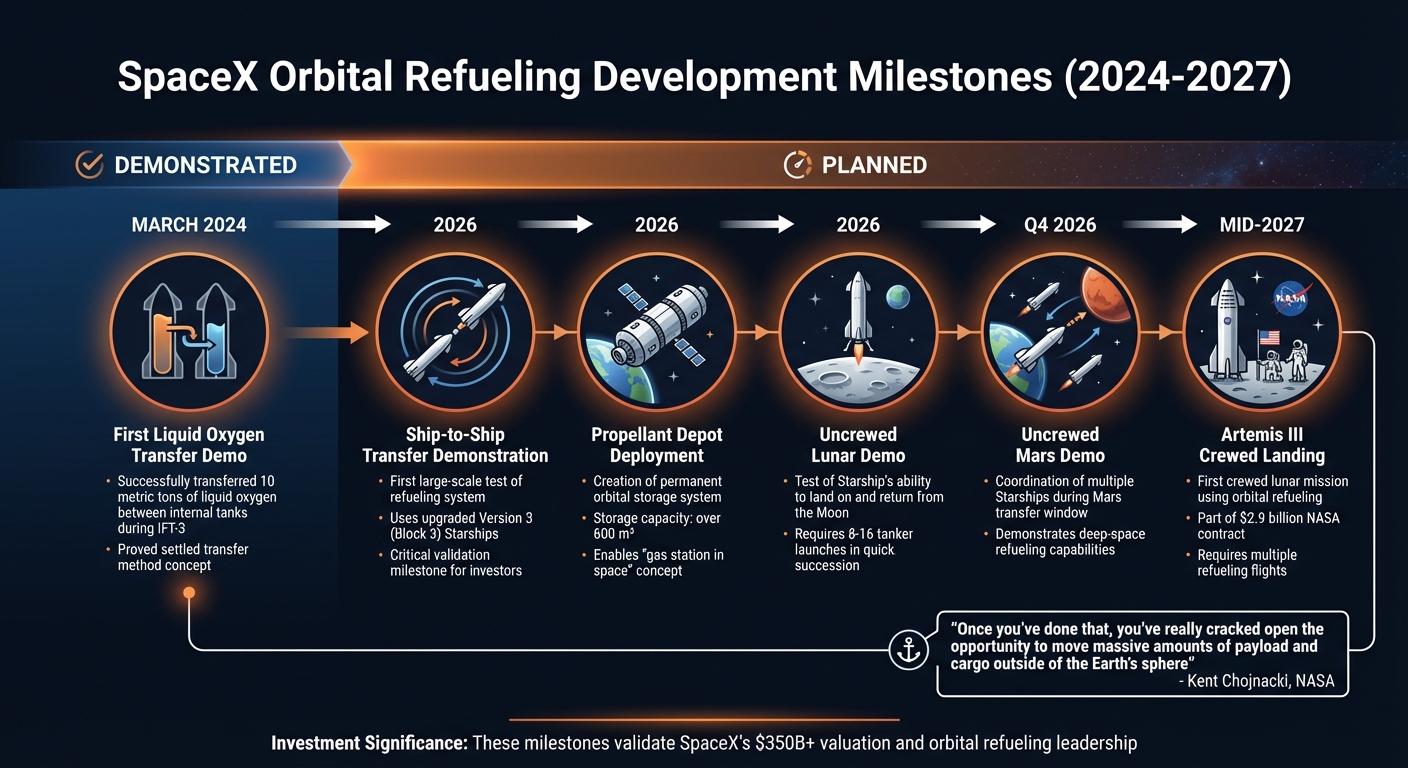
SpaceX Orbital Refueling Milestones and Timeline 2024-2027
SpaceX is tackling the challenges of orbital refueling with a combination of advanced technologies and innovative solutions designed to make deep-space missions more efficient and reliable.
The Starship Refueling System
At the heart of SpaceX's strategy is a pressure-fed propellant transfer system. This system relies on a pressure differential to move fuel through umbilical connections in space. To address the complications of microgravity - where liquids tend to float and disperse - the system uses settling thrusters. These thrusters create a slight artificial gravity, around 0.001G, which helps keep the liquid propellants near the transfer valves for a stable flow during the process.
SpaceX has built this system using tried-and-tested technologies. For instance, Starship incorporates autonomous docking techniques and DragonEye LIDAR sensors, both of which were successfully used with the Dragon spacecraft. To reduce propellant loss due to boil-off, the refueling system employs vacuum-jacketed plumbing and multi-layer insulation, keeping boil-off rates below 0.1% per day.
In March 2024, during its third integrated flight test (IFT-3), SpaceX successfully demonstrated this refueling method by transferring about 10 metric tons of liquid oxygen between internal tanks while in orbit. Studies suggest that this settled transfer method could retain over 80% of the launched propellant as usable fuel, a critical factor for enabling future space missions.
Autogenous Pressurization Technology
Another key innovation in SpaceX's design is autogenous pressurization. This system uses the natural boil-off of cryogenic propellants to pressurize fuel tanks, eliminating the need for heavy external pressurants. The vented gas also provides a small milli-G acceleration, which further helps settle the propellant. For instance, a pair of spacecraft weighing 100 metric tons could maintain an acceleration of just 0.0001G by consuming only 45 kilograms of propellant per hour.
This approach not only simplifies the spacecraft's design by reducing mechanical complexity but also enhances safety by minimizing potential failure points. It’s a forward-thinking solution that paves the way for SpaceX's ambitious 2026 orbital test milestones.
Timeline for Orbital Refueling Tests
SpaceX has set an ambitious schedule to validate its orbital refueling capabilities. By 2026, the company plans to demonstrate ship-to-ship propellant transfer using upgraded Version 3 (Block 3) Starships, which are specifically designed for managing cryogenic fluids in space.
| Milestone | Timeline | Significance for Investors |
|---|---|---|
| Ship-to-Ship Transfer Demo | 2026 | First large-scale test of the refueling system |
| Propellant Depot Deployment | 2026 | Creation of a permanent orbital storage system with over 600 m³ capacity |
| Uncrewed Lunar Demo | 2026 | Test of Starship's ability to land on and return from the Moon |
| Uncrewed Mars Demo | Q4 2026 | Coordination of multiple Starships during a Mars transfer window |
| Artemis III Crewed Landing | Mid-2027 | First crewed lunar mission, requiring multiple refueling flights |
NASA's Kent Chojnacki, Deputy Manager of the Human Landing System program, highlighted the importance of these efforts:
"Once you've done that, you've really cracked open the opportunity to move massive amounts of payload and cargo outside of the Earth's sphere"
The 2026 timeline will be a critical proving ground for SpaceX's orbital refueling system. With a single lunar mission requiring between 8 and 16 tanker launches in quick succession, flawless execution will be key. For investors, these milestones offer clear indicators of SpaceX's ability to deliver on its vision. To explore further details about SpaceX's progress and market potential, visit the SpaceX Stock Investment Guide.
What Orbital Refueling Success Means for Investors
Growth Potential in Space Logistics Markets
The in-orbit refueling market, currently valued at $1.2 billion in 2024, is expected to grow to $6.7 billion by 2034, with a projected annual growth rate of 18.4%. This technology is reshaping space logistics, opening up a new frontier for investment opportunities.
Orbital refueling has the potential to shift space operations from costly, single-use missions to a more sustainable service model. The U.S. Space Force is already advocating for "orbital gas stations" to extend the lifespan of satellites and enhance their capabilities, such as evasive maneuvers. General Stephen Whiting, Commander of the U.S. Space Force, highlighted the importance of this transition:
"The US should look to deploy orbital gas stations to maintain its space superiority"
Beyond satellite life extension, orbital refueling supports debris management and deep-space cargo transport. By reducing overall launch costs by up to 30% over the next decade, this technology makes space-based services more affordable and accessible, creating a strong foundation for investors interested in advanced space logistics.
SpaceX's Lead in Orbital Refueling Technology
SpaceX has firmly established itself as the leader in orbital refueling technology. It is currently the only organization capable of demonstrating large-scale cryogenic propellant transfer in space. While competitors like Lockheed Martin and United Launch Alliance are working on similar capabilities, their first flight demonstrations aren’t expected until 2025 or 2026. In contrast, SpaceX has already showcased its technology at scale.
This technological edge has significantly boosted SpaceX’s valuation. By late 2025, the company's value skyrocketed from $210 billion to approximately $350 billion, with orbital refueling breakthroughs being a major factor. Analysts predict that if SpaceX goes public, its valuation could range between $800 billion and $1.5 trillion.
SpaceX’s refueling capabilities also play a critical role in its $2.9 billion NASA Human Landing System contract for the Artemis III mission, positioning the company as NASA’s exclusive provider for initial lunar landings. George Sowers, former Chief Scientist at United Launch Alliance, summed up the industry’s perspective:
"In my mind, all the technical issues associated with cryo transfer in space are solved. It's just a matter of demonstrating it and fine-tuning the technology and the procedures. I think we're on the cusp"
With its clear technological lead, SpaceX offers unique opportunities for investors, including those looking to get in before a potential IPO.
Pre-IPO Investment Options in SpaceX and Starlink
Since SpaceX remains a private company, investors can access shares through secondary markets, SPVs (Special Purpose Vehicles), or certain funds. SPVs allow investors to pool their capital to acquire pre-IPO shares.
For those seeking indirect exposure, some publicly traded funds hold positions in SpaceX. Examples include the ARK Venture Fund (ARKVX), Baillie Gifford US Growth Trust, and select Fidelity growth funds. These funds provide an easier way to invest, though they don’t offer the same direct exposure to SpaceX’s performance.
Another intriguing option is the potential spinoff of Starlink. While SpaceX plans to stay private, CEO Elon Musk has suggested that Starlink may pursue an IPO once its cash flow stabilizes. By late 2025, Starlink had over 8.5 million subscribers and accounted for roughly 70% of SpaceX’s total revenue. A Starlink IPO could give retail investors a chance to benefit from the broader success of SpaceX, including its advancements in orbital refueling.
For more details on accessing pre-IPO opportunities and SpaceX’s valuation, check out the SpaceX Stock Investment Guide.
Conclusion: Orbital Refueling's Future and Investment Opportunities
What Investors Need to Know
Orbital refueling blends cutting-edge technology with promising commercial potential. SpaceX has firmly established itself as a frontrunner in this field, and its early lead is crucial. Refueling capabilities are a cornerstone for advancing space logistics and enabling deeper space exploration.
SpaceX's progress in this area is tied to its $2.9 billion NASA contract, its specialized on-site infrastructure, and Elon Musk's broader vision of achieving full reusability. These elements are critical for making multiplanetary missions a reality .
"Full & rapid reusability of booster & ship and orbital refilling of ship are the 2 fundamental technologies we aim to solve by the end of next year. Those are the critical pieces necessary to make life multiplanetary"
Grasping the challenges and solutions SpaceX is addressing is key to understanding its competitive advantage. For investors, early opportunities to gain exposure - whether through secondary markets, SPVs, or a potential Starlink spinoff - could offer a pathway to benefit from SpaceX's leadership in this emerging refueling framework. To dive deeper into pre-IPO strategies and stay updated on SpaceX's advancements, visit the SpaceX Stock Investment Guide for comprehensive insights and resources.
FAQs
What are the biggest challenges in developing orbital refueling technology?
Orbital refueling comes with a unique set of technical hurdles, largely due to the challenges posed by the space environment. One of the biggest issues is transferring fuel in microgravity. Without gravity to help, pressure control becomes critical to prevent leaks or damage to equipment. This means engineers need to design specialized connectors and valves that can handle these tricky conditions with precision.
Another significant challenge lies in creating autonomous systems for docking and fuel transfer. Since these operations need to run smoothly without human involvement, they rely on advanced robotics and sophisticated software. On top of that, the refueling equipment must be built to last in the harsh conditions of space, enduring extreme temperatures and radiation over long periods.
Companies like SpaceX are making strides to tackle these obstacles. Through their Starship program, they’re testing in-orbit fuel transfer systems and automated technologies aimed at making orbital refueling safer and more reliable. These breakthroughs are key to supporting extended missions and unlocking new opportunities for space exploration.
What is SpaceX doing to address regulatory challenges for orbital refueling?
SpaceX is working through regulatory hurdles for orbital refueling by teaming up with NASA and the U.S. Space Force on testing and validation missions. These collaborations focus on conducting in-space refueling demonstrations to confirm the dependability of hardware interfaces and scalable refueling systems.
The initial missions are set to begin in 2025 and beyond, representing essential milestones in meeting regulatory requirements and pushing forward the technology required for ambitious space exploration projects.
What should investors know about opportunities in the orbital refueling market?
The orbital refueling market is shaping up to be a promising avenue for investment, with projections indicating rapid growth over the next decade. Industry estimates suggest the market could expand from $1.2 billion in 2024 to a staggering $6.7 billion by 2034, driven by technological advancements and the growing need for reliable satellite servicing. With annual growth rates hovering around 12.7%, the potential for substantial returns is clear.
Some of the most exciting opportunities lie in areas like commercial orbital refueling fleets, modular fuel systems, and advanced servicing capabilities for deep space missions. Major players, including SpaceX, NASA, and other private companies, are pouring resources into overcoming the technical hurdles of orbital refueling. This push is setting the stage for lucrative developments in both technology and infrastructure.
SpaceX stands out as a leader in this field, making notable progress in in-orbit fuel transfer technologies. These advancements could unlock entirely new investment possibilities. For those eyeing SpaceX or similar ventures, exploring private equity options before public offerings might be a strategic approach to gain early exposure to this emerging market.
Comments ()